Our Mission: Eliminating Administrative Latency in Property Restoration
LouisvilleLeakRecovery was engineered to resolve a critical, structural flaw in traditional property restoration frameworks: the devastating operational delay that occurs between a high-pressure appliance failure and the arrival of high-volume mechanical extraction assets. Throughout the residential communities of Jefferson County, municipal water networks deliver continuous, high-volume pressure loads to modern townhouse configurations and multi-level properties. When an internal appliance line breaches—whether it is a terminal material fatigue failure inside a 80-gallon water heater or a pressurized washing machine supply hose rupture—the escaping fluid does not behave like a passive leak. It mirrors an active line breach, releasing up to thirty gallons per minute directly into finished interior partition envelopes and horizontal floor assemblies.
Traditional corporate restoration networks often force property owners through extensive insurance intake loops, sub-contractor availability verifications, and administrative bottlenecks while water actively migrates through porous drywall layers and structural sub-flooring. Our foundational mission is to bypass this latency entirely. Operating as a high-velocity, high-intent telecommunications routing grid, our platform instantly aligns distressed real estate owners with localized, fully equipped independent recovery contractors across Louisville, Kentucky. By establishing a direct, automated pipeline between immediate consumer alerts and active field depots, we ensure that specialized emergency mitigation crews intercept structural flooding before building components reach their irreversible fiber saturation point.
 An on-duty technical coordinator manages the regional telemetry grid to route emergency recovery trucks across Jefferson County.
How We Work: The Technical Dispatch & Routing Sequence
To consistently execute our targeted 40-to-45 minute response window across the greater Louisville metro framework, all independent mitigation contractors in our database operate under a standardized, non-negotiable emergency deployment sequence. The process is governed by telemetry precision, minimizing human error and ensuring rapid asset placement when an active fluid emergency is logged through our routing lines:
- Immediate Incident Intake & Triage: The moment a property owner initiates a live connection, our central routing grid captures the geographic coordinates and categorizes the incident based on the IICRC S500 fluid contamination matrix, confirming whether it is an active water heater tank burst or a kitchen appliance line failure.
- Tactical Fleet Asset Matching: The automated system analyzes the real-time GPS locations of all uncommitted heavy-duty vehicles across our designated regional partner depots, matching the incident with the closest specialized field truck.
- Rapid High-Vacuum Deployment: Staged near critical transportation veins like the I-64, I-65, and I-264 bypass corridors, the designated response vehicle is dispatched instantly, carrying all necessary psychrometric diagnostic tools, industrial LGR units, and high-lift extraction pumps directly to the coordinates.
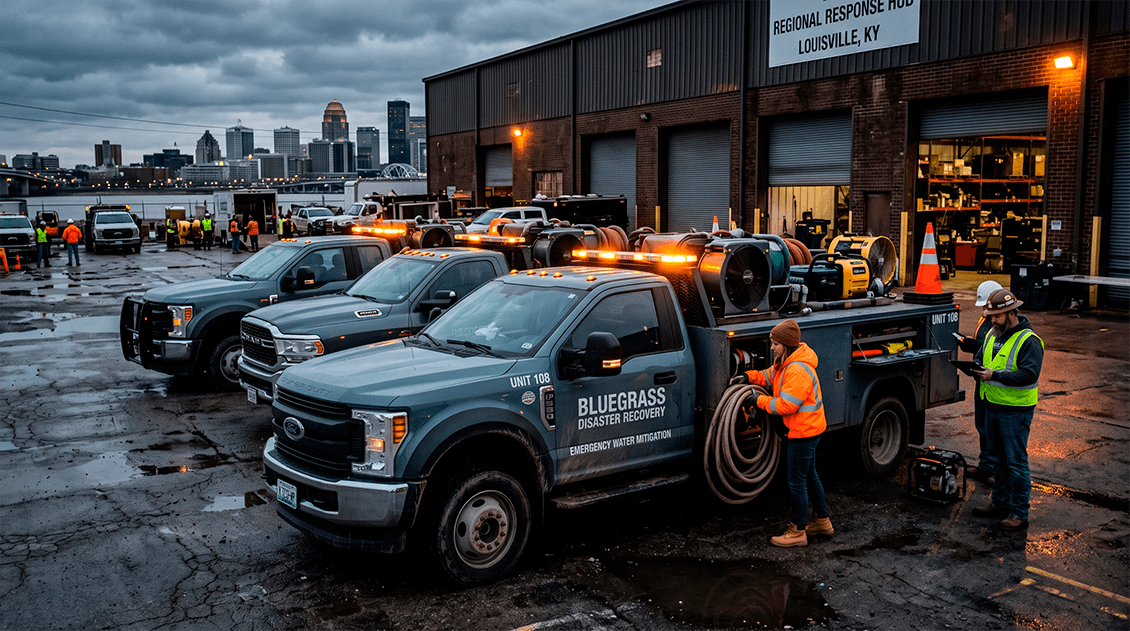 Our designated regional partner depots maintain staging areas of heavy-duty trucks and high-capacity machinery to ensure immediate dispatch readiness across Jefferson County.
Strict Psychrometric Engineering & Structural Drying Standards
True emergency property recovery after an internal line breach is an exact science that requires deep technical expertise, not just basic custodial cleanup. Saturated concrete foundations, dense wooden wall sills, and sub-floor underlayments hold bound water molecules deep within their microscopic pore structures. Simply drying the surface layers with retail household fans leaves the deep core structure vulnerable to wood rot, permanent structural shifting, and severe material breakdown. The independent restoration professionals in our database approach every project using advanced psychrometric engineering principles to force deep-seated moisture out of building elements.
Technicians strictly monitor ambient indoor temperatures, relative humidity thresholds, grains per pound (GPP) moisture ratios, and dew point metrics to create an intense vapor pressure deficit between the wet structural components and the surrounding air envelope. Industrial Low-Grain Refrigerant (LGR) dehumidifiers are deployed alongside high-velocity axial air movers positioned at precise 45-degree tactical angles along baseboards. This continuous airflow breaks up the stagnant boundary layer of saturated air, forcing embedded moisture to evaporate rapidly out of wood framing and concrete matrices where it is captured and compressed by the LGR desiccant fields.
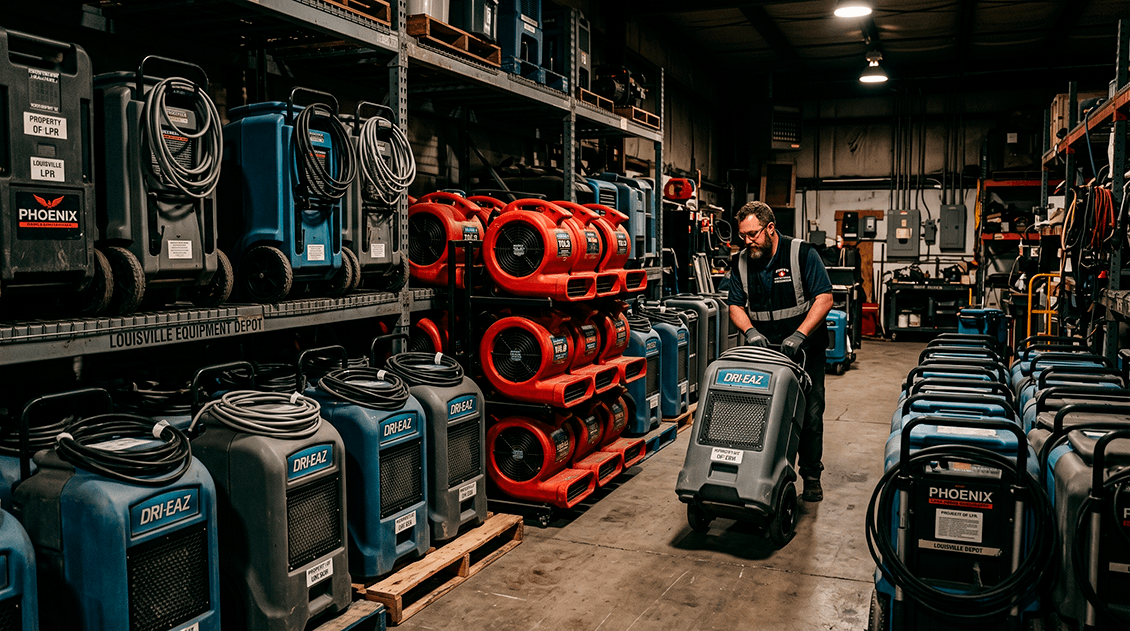 Our designated regional partner depots maintain staging areas of heavy-duty air movers and high-capacity systems to ensure immediate dispatch readiness across Jefferson County.
Pathogenic Control and EPA-Registered Sanitation Protocols
Biological contamination is a major secondary hazard when dealing with appliance overflows. Water discharged from laundry systems or commercial dishwashers carries heavy loads of organic compounds, chemical surfactants, and industrial detergents. Under IICRC guidelines, this is strictly classified as Category 2 grey water. If left unmitigated within dark wall voids, floor truss cavities, or insulation layers for more than 24 to 48 hours, these high-nutrient fluids rapidly mutate into dangerous Category 3 black water as dormant organic bacterial strains and microbial spores multiply exponentially.
To prevent this toxic mutation and ensure long-term biostatic control, routed field technicians implement immediate chemical countermeasures. Using professional manual pressure pumps, specialists apply EPA-registered broad-spectrum antimicrobial sanitizers and botanical disinfectants directly to exposed structural sills, vertical wooden studs, and floor plates. This application halts organic breakdown, hospital-grade decontaminates the grid, and prevents dangerous microbial colonies from establishing a foothold inside the property envelope, protecting the long-term health and air quality of the home.
Comprehensive Claim Records & Insurance Audit Compliance
Navigating a major property loss insurance claim after an upper-level appliance failure can be an incredibly stressful process for property owners. Corporate insurance adjusters thoroughly audit local water incidents, often leveraging incomplete records or documentation gaps to delay coverage, limit claim payouts, or deny coverage entirely. They demand clear, independent, and verifiable proof that the water damage was sudden and accidental, and that proper mitigation steps were taken immediately under IICRC S500 guidelines to prevent secondary mold growth.
The independent restoration professionals in our database eliminate this administrative friction by preparing exhaustive, court-ready digital documentation packages for every deployment. These comprehensive files track initial thermal infrared scans that locate hidden water pathways inside walls, daily atmospheric moisture metric charts, equipment runtime logs, and official final structural dry-standard verifications. Providing insurance adjusters with this complete, highly detailed technical record pack streamlines the entire settlement process. It helps property owners throughout Louisville, St. Matthews, Highlands, and Jeffersontown validate their claim paths, secure clean and transparent payouts, and fully protect their real estate investments without unnecessary processing delays.