The Destruction Blueprint of Washing Machine Leakage
Washing machine leaks in Louisville residential properties are frequently dismissed as minor maintenance issues until the structural impact manifests as a full-scale flood. A standard laundry supply line breach can discharge hundreds of gallons per hour. Given that laundry units are often located in interior alcoves or near finished living spaces, this water does not simply evaporate. It tracks laterally across sub-floor underlayments and descends vertically through stud bays. In Louisville’s varying housing stock, from older timber-frame homes to modern concrete-slab structures, this infiltration triggers immediate delamination and structural rot. The severity of the loss is directly tied to the temporal gap between the rupture event and the deployment of professional extraction assets. Properties in older districts like the Highlands or Crescent Hill feature vintage joist systems that are uniquely susceptible to high-moisture exposure, turning a localized appliance leak into a long-term foundation risk.
Beyond the surface-level inconvenience, a washing machine leak creates an invisible subterranean moisture profile. Modern washing machines, particularly high-efficiency front-load units, operate at spin velocities exceeding 1200 RPM. This extreme mechanical stress, coupled with constant thermal cycling, causes internal supply lines and pump seals to undergo rapid fatigue. When these components fail, the resulting release is under municipal pressure, forcing water into the absolute tightest construction seams. Once water breaches the sub-floor surface, it creates an environmental hazard that standard residential remediation cannot address. The moisture-laden air trapped within structural cavities promotes microbial growth that can be detected via professional thermographic scanning within hours of the initial release.
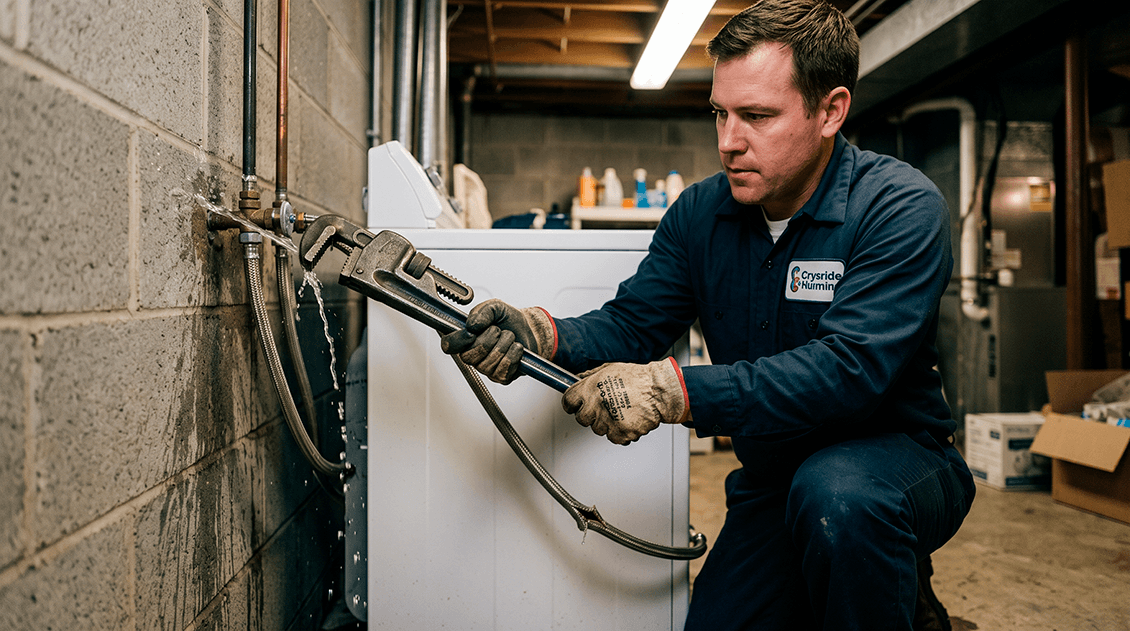 Professional diagnostic triage isolates the rupture source before executing mechanical component replacement.
Technical Protocols for Mechanical Leak Repair
Repairing a washing machine leak requires a systematic deconstruction of the mechanical assembly to isolate the point of failure. Our technicians perform a multi-point mechanical triage to identify the root cause using digital diagnostics and hydraulic pressure testing. We systematically evaluate the following failure vectors to determine if the unit can be restored to factory operational parameters:
- Supply Hose Fatigue: Rubber-composite supply lines have a finite service life. We inspect for brittle exterior casings and internal wall thinning. Replacement with reinforced steel-braided lines is the standard procedure to prevent repeat catastrophic ruptures.
- Drain Pump Integrity: The drain pump housing is often subjected to severe vibration-induced micro-fractures. We verify pump seals, impellers, and mounting gaskets, ensuring that the evacuation sequence remains leak-free under peak drainage loads.
- Internal Gasket Failure: High-torque spin cycles exert irregular pressure on drum seals. We perform localized inspections of the main door boot seal and secondary internal distribution gaskets to prevent misting and spray patterns during extraction cycles.
- Pressure Switch Calibration: Incorrect water level detection can cause the drum to overfill, putting excessive strain on door seals. We calibrate the pressure transducer to ensure the drum maintains the correct hydrostatic level.
Industrial Extraction vs. Structural Saturation
When a leak floods your flooring, shop-vacuums are insufficient. Standard residential suction cannot overcome the capillary action that pulls water deep into dense fiber padding and sub-floor pores. Our dispatch teams deploy truck-mounted extraction platforms capable of creating deep sub-surface vacuum draw. This industrial process pulls trapped fluid from beneath flooring materials, halting the progression of mold and structural warping. By maintaining a negative-pressure environment during the repair and extraction phase, we create an audit-ready environment that provides you with technical documentation for insurance purposes. We treat the laundry room as a pressurized containment zone, utilizing high-lift pumps to evacuate standing pools and high-mass weighted extraction heads to compress materials and draw out fluid from the core of the sub-floor assembly.
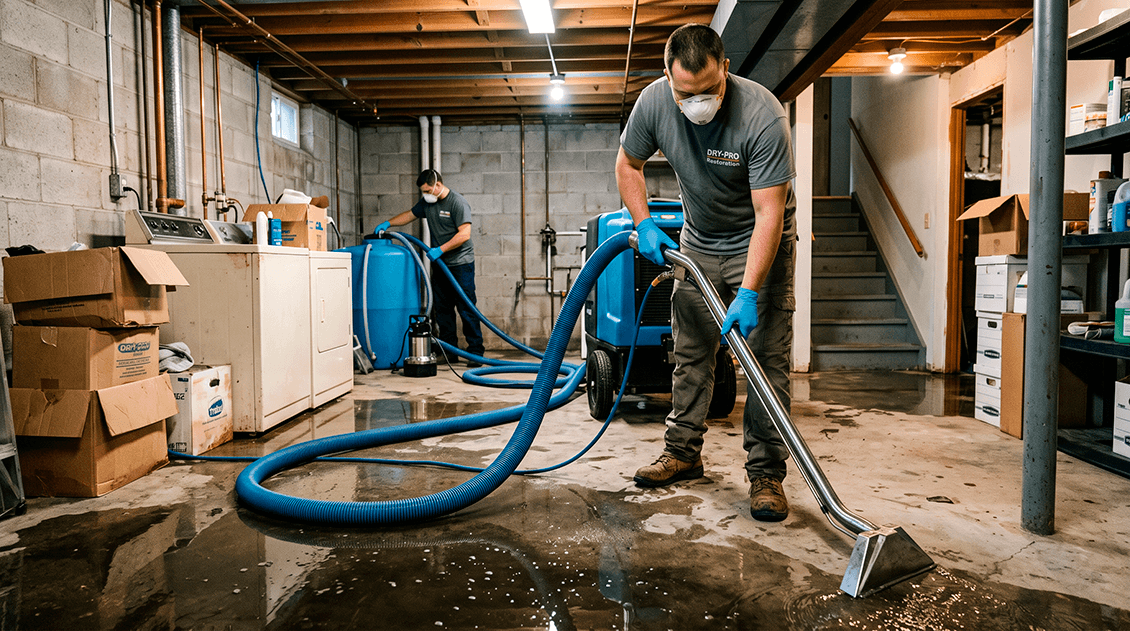 Professional extraction crews remove standing water from basement laundry room flooring to prevent structural saturation.
Environmental Stabilization and Psychrometrics
Once the bulk fluid is evacuated, the focus shifts to psychrometric stabilization. Building materials—timber framing, drywall, and concrete—are hygroscopic, meaning they hold bound moisture that can only be extracted through controlled environmental manipulation. We deploy industrial Low-Grain Refrigerant (LGR) dehumidifiers which operate effectively even in the high-heat, high-humidity environment generated by a basement or laundry area leak. By lowering the grain-per-pound (GPP) ratio of the surrounding air, we force moisture to migrate out of the building materials at an accelerated, yet controlled rate. This process is monitored via daily moisture tracking logs. These logs do not merely document the presence of equipment; they provide a scientific timeline of the structural drying process, verifying that your home’s air and material moisture content have returned to safe, stable levels that meet professional restoration standards.
Why Professional Mitigation is Critical for Claims
Insurance companies demand verifiable proof of immediate mitigation for any appliance leak. Our dispatch process generates an immutable, timestamped data record for every truck deployment. This includes telemetry on initial on-site moisture readings, the precise mechanical failure point identified during diagnostic triage, and the drying log verification performed during the stabilization phase. By utilizing this professional approach, you ensure that your claim is processed with the technical evidence required to avoid denial, while our repair crews verify that your machine returns to factory performance standards. Don't let a small leak turn into a structural disaster—route our local fleet now. We provide the technical evidence trail that prevents claim reduction and ensures your property is restored to its full pre-loss condition.
Our operational architecture in Louisville is specifically designed to eliminate the friction between property owners, appliance functionality, and the complex requirements of modern property insurance policies. When you initiate a fleet dispatch, you are not just getting a repair technician; you are engaging an entire operational grid dedicated to restoring your laundry utility while documenting the entire lifecycle of the damage event. This is the difference between a temporary patch and a certified, compliant restoration of your home's integrity.